What is a launch window and why do missions miss them?
A rocket can be fully fuelled, its payload checked, its countdown rehearsed to the second — and still sit on the pad for two hours because of one cumulus cloud drifting over the sea. That is not bad luck, and it is not indecision. It is the launch window doing its job.
A launch window is the period during which a rocket can lift off and still reach the orbit or trajectory the mission requires. Miss it and you do not simply arrive late. You arrive in the wrong place, with the wrong amount of fuel left, or you do not arrive at all.
Why a window exists in the first place
Orbit is a relationship between speed and position, and the thing you are chasing is usually moving fast. The International Space Station crosses the sky at around 7.7 kilometres per second while the Earth turns beneath it. A launch site sweeps through the plane of any given orbit roughly twice a day; the rest of the time, the geometry is wrong. Launch too early and you burn fuel chasing the target around the curve of the planet. Launch too late and it has moved beyond the reach of your upper stage.
The Earth's rotation helps as well as hinders. A launch from near the equator gets a free eastward push of up to about 465 metres per second, which is one reason so many launch sites sit as close to the equator as politics and geography allow. That same rotation, though, means the ground is sliding under every orbit you might want to reach — so a mission with a comfortable window today can have no window at all tomorrow.
The three kinds of window
Rendezvous flights
Anything flying to a space station has the tightest constraints. The launcher must arrive in the same orbital plane as the station and at the right point in the phasing cycle, so the capsule can catch up without wasting propellant. That produces windows measured in minutes, and for the fast-track rendezvous profiles used by Soyuz and Crew Dragon, sometimes a handful of seconds. If the count stops at T-20 seconds, the day is usually gone.
Sun-synchronous and polar launches
Earth-observation and some weather satellites need to cross the equator at the same local solar time on every orbit, so the lighting on the ground stays consistent. The launcher therefore has to depart at a particular time of day, not merely whenever the range is free. Launch an hour late and the satellite still works, but the local crossing time drifts and the mission's images are no longer comparable with its predecessors'.
Interplanetary departures
For Mars, the geometry only lines up about every 26 months. Within that, the window may stay open for several weeks, but the best-performing days sit near the middle. The spacecraft must leave along a specific departure asymptote, which is why a Mars launch that slips past its final opportunity can mean a two-year wait and a redesign of the cruise phase. Missions to other planets have their own rhythms, some more forgiving than others.
Weather and range: the unglamorous limits
Weather rules exist mainly to protect against lightning, not rain. A rocket climbing through a charged cloud can trigger a strike, so forecasters watch for cumulus build-ups, anvil clouds spreading from thunderstorms, and any disturbed weather within roughly 10 nautical miles of the pad. They also look at wind shear, ground winds that could push the vehicle into the tower, and high-altitude winds that could stress the structure or the payload fairing.
Weather is only half of it. The range — the launch site and the tracking and safety infrastructure around it — has to be clear. That means:
- Airspace and marine exclusion zones free of aircraft and boats.
- Radar and telemetry stations downrange staffed and working.
- Flight termination systems armed and checked, so a veering rocket can be destroyed safely.
- No conflicting launch or re-entry operations, and no threatening conjunction with another object in orbit.
- Sea conditions suitable for booster recovery, if the mission plans to land one on a ship.
Why missions miss them
Most scrubs are ordinary engineering caution rather than drama. A sensor reads out of limits. A ground valve sticks. A range ship drifts into the exclusion zone. A balloon sounding the upper atmosphere comes back with winds above the vehicle's limit and the next one cannot be launched quickly enough. Sometimes the count is stopped for a few minutes and then resumes, and the mission still flies inside the same window.
It is worth knowing the vocabulary. A hold pauses the count, and if it is short enough the launch can continue. A scrub cancels the attempt for the day. A recycle restarts the terminal count — useful if there is time left in the window, but if the window closes there is nothing to recycle into.
Reading a launch window like a pro
When you look at a launch schedule, find the words "window opens" and "window closes" before you look at anything else. A six-hour window usually means the flight only has to reach a general orbit or trajectory, so holds are relaxed and delays are common. An instantaneous window means exactly what it says: there is one moment, and a few seconds either side of it do not work.
If you are travelling to watch a launch, build in spare days and treat the first attempt as a rehearsal. Follow the launch provider's own updates rather than a third-party countdown app, which often keeps ticking through a hold. And if a launch is scheduled for the start of its window, expect it to go briskly; if it sits at the end, expect the team to hold and wait for a better moment.
Missing a window is usually the system working, not failing. The rocket is fine, the payload is fine, and the alternative — launching into a sky or an orbit that does not suit — would be far more expensive than waiting.
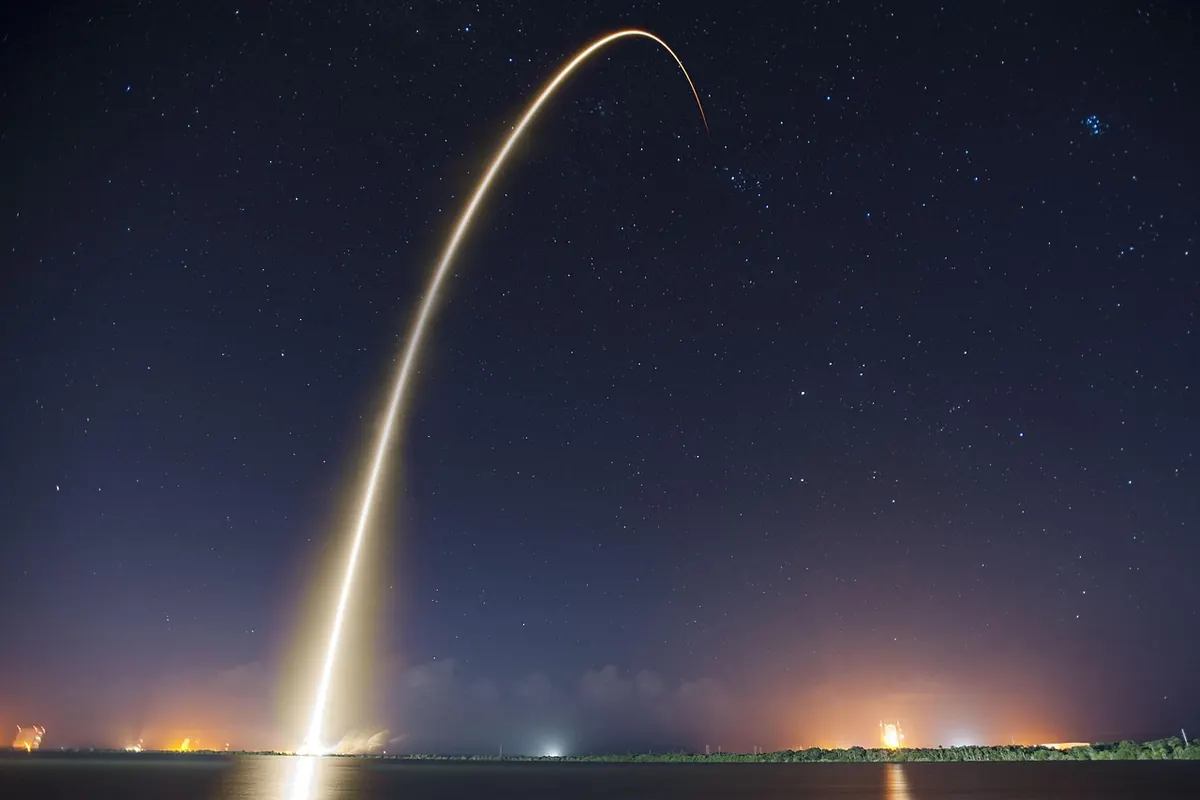
Photo: SpaceX-Imagery / Pixabay