Best winter stargazing targets in the UK: a seasonal guide
Winter gives the UK some of the worst weather of the year and, on the clear nights, some of its finest stargazing. Darkness falls before teatime in December and January, the cold air is often cleaner than summer's muggy haze, and the brightest constellation of all sits high in the south. You do not need a big telescope or a remote hillside to enjoy it — a warm coat, half an hour and a pair of binoculars will take you a long way.
Why the winter sky rewards a little discomfort
Two things change in winter. The first is timing: you can start observing at six in the evening and still be indoors by nine. The second is transparency — how cleanly the sky lets light through. Cold air holds less moisture, so faint stars look crisper than they do in July, and the winter Milky Way becomes a soft band of light running through Orion, Gemini and Auriga.
Seeing — the steadiness of the air — is a different matter. When the jet stream parks itself over Britain, high-magnification views of the Moon and planets wobble and boil. Expect to be limited by the atmosphere on some nights and delighted by deep-sky objects on others, and check both a cloud forecast and an astronomy seeing forecast before committing to a long drive.
Frost and dew are the everyday nuisance. Eyepieces fog over, telescope tubes drip, and fingers go numb on metal focusers. A dew shield, a flask and a pair of gloves with fold-back fingertips solve most of it.
Orion: start with the easiest constellation in the sky
Orion is unmistakable: three bright belt stars in a near-perfect line, with orange Betelgeuse at one shoulder and blue-white Rigel at the opposite foot. The belt runs from Alnitak through Alnilam to Mintaka, and hanging below it is the sword — the fuzzy middle "star" of which is not a star at all.
That patch is the Orion Nebula, M42, a stellar nursery roughly 1,300 light-years away. Binoculars show it as a hazy grey-green glow. Through a small telescope at low power you can pick out the Trapezium, a tight group of young stars lighting the nebula from within, and the darker lane cutting across the brighter half. Use averted vision — look slightly to one side of the nebula rather than straight at it — and more detail appears. An oxygen-III or UHC filter helps from suburban gardens.
Elsewhere in Orion, the Flame Nebula sits beside Alnitak, and the Horsehead Nebula lurks just south of it. The Horsehead is a genuine challenge: it needs a truly dark site, a hydrogen-beta filter and a large aperture. Treat it as a long-term project rather than a first-night target.
Taurus: the Pleiades and the Hyades
Follow the belt upwards and to the right and you arrive in Taurus, which holds two clusters that suit binoculars better than telescopes.
The Pleiades, M45, is the little knot of stars that looks like a tiny saucepan. Most people see five or six stars with the naked eye; from a dark site, a dozen. Ten-by-fifty binoculars turn it into two dozen blue-white points of light, and photographs reveal the reflection nebulosity the cluster is passing through. You need the widest field you can get — a telescope at high power will show only a couple of stars at a time.
Below and to the right again is the Hyades, the V-shaped face of the bull, with orange Aldebaran marking the upper point of the V. Aldebaran is a foreground star, not a member of the cluster, but it makes a fine colour contrast with the white stars behind it. Sweep the whole region slowly: this part of the sky is rich with pairs and small groups.
Andromeda and the view beyond our galaxy
The Andromeda Galaxy, M31, is the most distant object most people ever see with the naked eye — about 2.5 million light-years away. It is also well placed for UK observers, since at a declination of roughly +41° it passes close to overhead on autumn and winter evenings.
To find it, start at Alpheratz, the corner star Andromeda shares with the Great Square of Pegasus. Hop along the chain of stars — Delta, then Mirach — then turn north to Mu Andromedae. M31 sits just beyond Mu. From a dark site it is a large, elongated smudge; from a town it is invisible, so save it for a rural night.
Through binoculars you will see the bright core and, with care, two smaller companions: M32 close by and M110 further out. Nearby Triangulum holds M33, a face-on spiral that is genuinely difficult in British skies — a test object for a transparent, moonless night.
Auriga, Gemini and the rest of the winter circuit
Capella in Auriga is almost overhead on winter evenings, and the constellation's three open clusters — M36, M37 and M38 — form a neat line for binoculars or a low-power telescope. M37 is the richest of the three.
To the south-east, Gemini's twin stars Castor and Pollux sit side by side; Castor splits into a beautiful double in a small telescope. Between the twins' feet lies M35, a large, bright cluster. Draw an imaginary triangle between Betelgeuse, Sirius and Procyon and you have the Winter Triangle; add Capella, Aldebaran, Rigel and Pollux and you have the Winter Hexagon.
Sirius, the brightest star in the night sky, never climbs high from UK latitudes, and that low altitude makes it twinkle violently, flashing red, white and blue. That is atmospheric refraction, not the star itself. Sweep below it into Canis Major for M41, and follow the winter Milky Way through Monoceros for the Rosette Nebula, a filter-friendly target for dark skies.
Remember that the sky turns: Orion is highest around midnight in mid-December, but by late January it is already well placed by nine in the evening.
Practical tips for cold UK nights
- Let your eyes adapt. Twenty to thirty minutes in darkness makes an enormous difference. Use a red torch or a dimmed screen, and shield your eyes from streetlights and car headlights.
- Check the Moon. The fortnight around new Moon is prime deep-sky time; a bright Moon washes out nebulae and galaxies but is superb for craters.
- Cool the telescope. Optics need twenty to thirty minutes outside to reach ambient temperature, otherwise high-power views stay mushy.
- Beat the dew. Fit a dew shield, keep spare eyepieces in a pocket, and never breathe on a lens.
- Dress for standing still. Thermal layers, a hat, insulated boots and a sit-down stool beat any gadget. Sitting also steadies the view.
- Start with binoculars. A 10x50 pair will show the Pleiades, the Orion Nebula, M31 and dozens of clusters. They are also the fastest thing to grab when a gap in the cloud appears.
- Work with your sky. In a town, target open clusters, double stars and the Moon; save faint galaxies and nebulae for a dark-sky site such as Kielder, Galloway, Exmoor or the Brecon Beacons.
- Keep a log. A notebook of dates, conditions and sketches turns random evenings into a record you can build on.
A simple 90-minute plan
- Set up and let your eyes and optics adapt while you find Orion's belt.
- Spend ten minutes on the Orion Nebula, trying different magnifications and averted vision.
- Swing up to the Pleiades and the Hyades with binoculars.
- Star-hop to M31 if your sky is dark enough; if not, find M35 and the Auriga clusters.
- Finish on something bright — Castor, Aldebaran or Sirius — then go inside and warm up.
Making the most of the season
Winter stargazing is mostly about seizing the gaps. Watch the forecasts, keep binoculars by the back door, and treat a clear hour as a win rather than waiting for a perfect night that never arrives. If you can, plan a trip to a dark-sky area and combine it with a walk the next morning.
Take sensible precautions in cold weather: tell someone where you are going, take a charged phone and a torch, avoid icy paths and steps in the dark, and do not drive home tired. Frost, fog and gritted roads are more of a risk than anything in the sky. Get the basics right, and the coldest months will quietly become the best ones in your observing year.
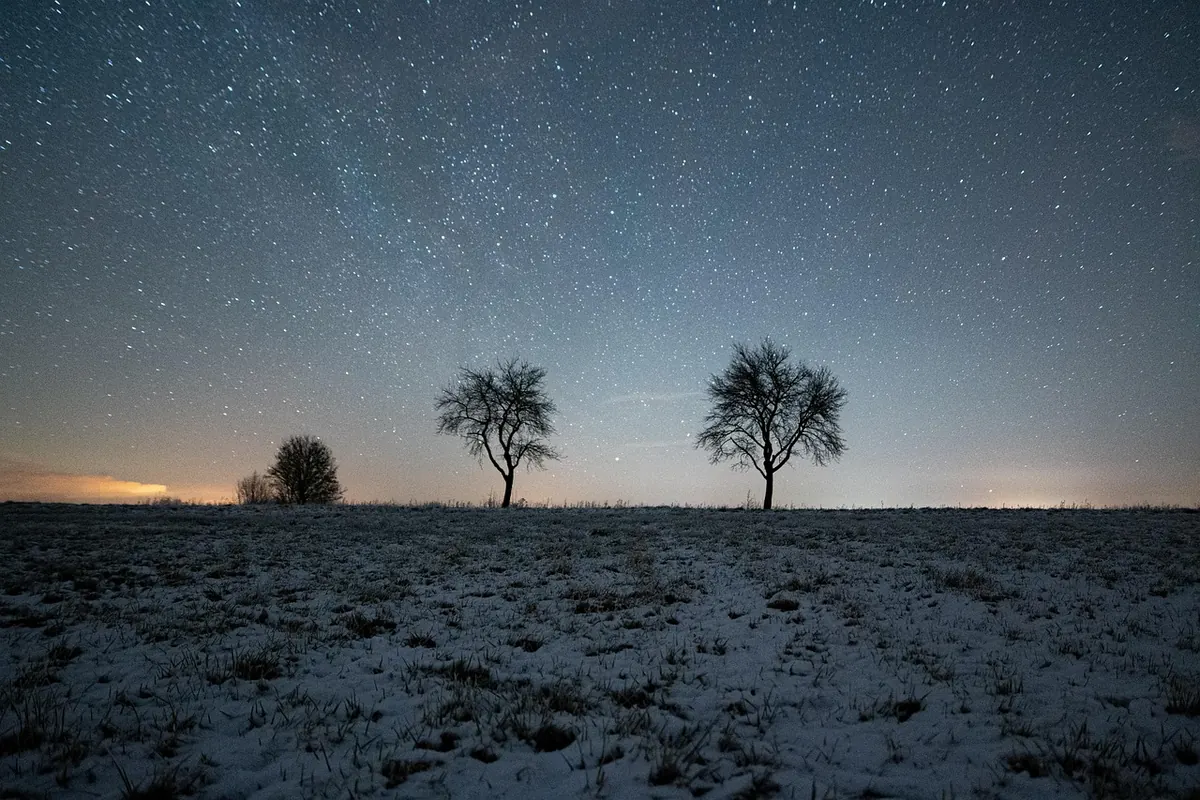
Photo: Manuel-H / Pixabay