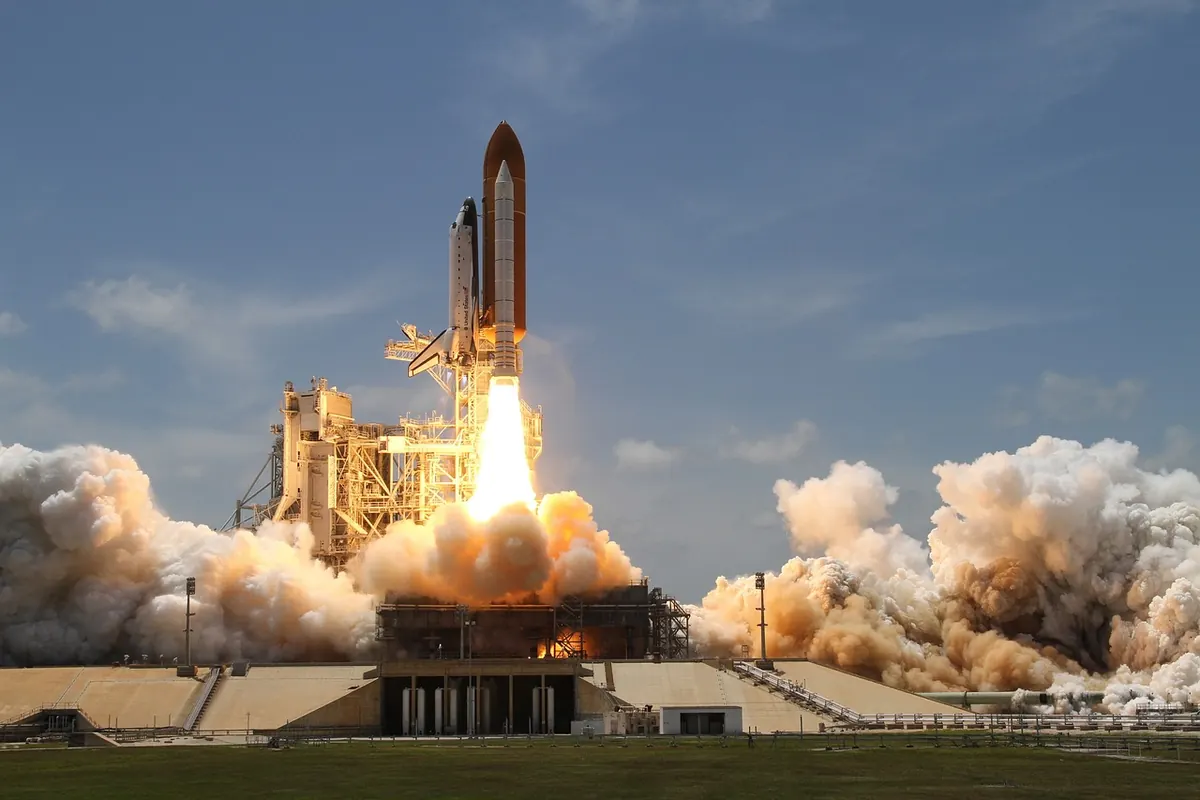
What happens during a rocket launch? A step-by-step explainer
The first seconds of a rocket launch look like violence and sound like weather. What is actually happening is closer to a very long checklist being read aloud. Every milestone, from engine ignition to fairing separation, exists because something went wrong once and engineers decided it never would again. Here is the order of events, from the moment the countdown clock starts ticking to the moment the payload is on its own.
The countdown is a rehearsal, not a formality
Countdown clocks do not tick smoothly. They stop, sometimes for seconds, sometimes for hours. That is the point. Holds are built into the timeline on purpose so that teams can catch up on checks without resetting the whole operation. A hold is not a failure; it is the system working.
Before the clock gets anywhere near zero, the launch range has to be clear of ships and aircraft, weather balloons have been released to measure upper-level winds, and forecasters have checked for lightning, thick cloud and shear that could push the vehicle off course. For a satellite heading to a specific orbit, the launch window might last minutes. For a rendezvous with the International Space Station, it can close in seconds.
In broad strokes, the timeline runs like this:
- Hours before: the vehicle stands on the pad, the payload is enclosed, and teams run through electrical, guidance and communications checks.
- Roughly three hours out: propellant loading begins. Chilled kerosene, liquid hydrogen and liquid oxygen are pumped aboard, and you will see white vapour venting as the tanks breathe.
- Minutes before: tanks are pressurised, the flight computer takes over the count, and the water deluge system is armed to pour thousands of litres onto the pad.
- Seconds before: the ignition sequence starts. Engines light and build up thrust while the hold-down clamps keep the rocket bolted to the pad.
- T-zero: clamps release. Liftoff.
Ignition and liftoff
Those last few seconds are doing real work. Turbopumps spin up to tens of thousands of revolutions per minute, engine chambers reach full pressure, and sensors confirm that thrust is where it should be. Only then do the clamps let go. If thrust is low, the computer shuts everything down on the pad rather than letting the vehicle lumber off the tower.
A rocket leaves the ground slowly, because its thrust-to-weight ratio at liftoff is only just above one. The first hundred metres take longer than you expect. The water deluge is not there for the flames; it is there to absorb sound, because acoustic energy reflected off the pad can crack structures. A lot of the deep crackle you hear from a distance is shockwaves rather than the engine note itself.
Once clear of the tower, the vehicle does not simply climb. It pitches over into a curved trajectory within the first minute, trading vertical height for the horizontal speed it will eventually need.
Max Q: the moment of greatest pressure
About a minute after liftoff, the rocket reaches a milestone called max Q, the point of maximum aerodynamic pressure. The vehicle is not at its fastest here, but the air around it is still thick enough to push back hard. Most launchers throttle down through this phase, easing the load on the structure before throttling back up.
On a launch webcast, you will usually hear the call "max Q" as a calm comment from the flight commentator. It is the quietest drama of the whole ascent, and arguably the most dangerous window before staging.
Staging: shedding what you no longer need
Most of a rocket at liftoff is propellant, and once that propellant is gone, the empty tank is dead weight that the next engine has to carry. Staging solves that problem by cutting the vehicle in half.
The first stage shuts down, small separation motors push the two sections apart, and the second stage engine ignites moments later. On vehicles with side boosters, those are jettisoned even earlier, often within the first two minutes. On a Falcon 9, first-stage separation happens roughly two and a half minutes after liftoff. Soyuz sheds four strap-on boosters in a distinctive cross pattern known as the Korolev cross, which is a genuine spectacle if you ever get the chance to watch it.
Two details matter here. First, the stages must push apart cleanly without tumbling back into each other. Second, propellant in a coasting upper stage floats, so small settling motors or a brief ullage burn are used to push the liquid to the bottom of the tanks before the main engine can light.
Fairing separation: the payload sees the sky
The payload sits under a nose cone, or fairing, that protects it from aerodynamic pressure, vibration and heating during the climb through the atmosphere. Once the vehicle is high enough that the air is thin, the fairing has done its job and is jettisoned, usually splitting into two halves that fall away. On a Falcon 9 that happens a little over three minutes into flight.
Those halves are expensive, which is why some operators now try to recover them with parachutes and boats. Not every rocket has one: crew capsules such as Dragon and Soyuz sit under a different kind of shroud, and some vehicles fly without any covering at all.
Orbital insertion: where altitude becomes orbit
This is the part most people misunderstand. Reaching space is not the same as reaching orbit. Altitude alone will not keep you up; you need horizontal speed. To stay in low Earth orbit, a spacecraft needs to be travelling at roughly 7.8 kilometres per second, about 28,000 kilometres per hour. At that speed, the curve of the Earth falls away beneath you as fast as you fall towards it.
So the final phase is mostly about speed. The second stage burns for several minutes, often in two separate firings with a coast in between, until the vehicle reaches the precise orbit required. Then the engine cuts off, the payload separates, and solar arrays or antennas deploy. For the rocket, the mission is finished. For the satellite, it has only just begun.
What to watch for on the next launch
Agency and company webcasts carry a live timeline, and the commentary follows the same milestones described above. If you want to follow along properly, a few things make it easier:
- Read the mission press kit before liftoff. It lists the key events with their T-plus times, so you know what is coming.
- Listen for the calls: ignition, max Q, stage separation, fairing separation, and main engine cutoff. They mark the whole shape of the flight.
- Count from T-zero yourself. Once you have watched two or three launches, you will start to feel when staging is due.
- Do not rely on seeing a launch from the UK. Most are far below the horizon, so the webcast is the practical option.
The next time you watch one, the noise will still be the loudest thing on screen. But you will know what the vehicle is doing at every stage of the climb, and that changes the experience completely.
Photo: WikiImages / Pixabay