How to spot the International Space Station from your garden: a UK viewing guide
The International Space Station is the brightest thing humans have ever put into orbit, and it passes over Britain most weeks. You do not need a telescope, a dark-sky site or a hilltop. You need a clear-ish patch of sky, a rough sense of direction, and a few minutes' notice. Get those three things right and a steady white point of light will slide across your garden, roughly 400 kilometres above you, at about 28,000 km/h.
What you are actually looking for
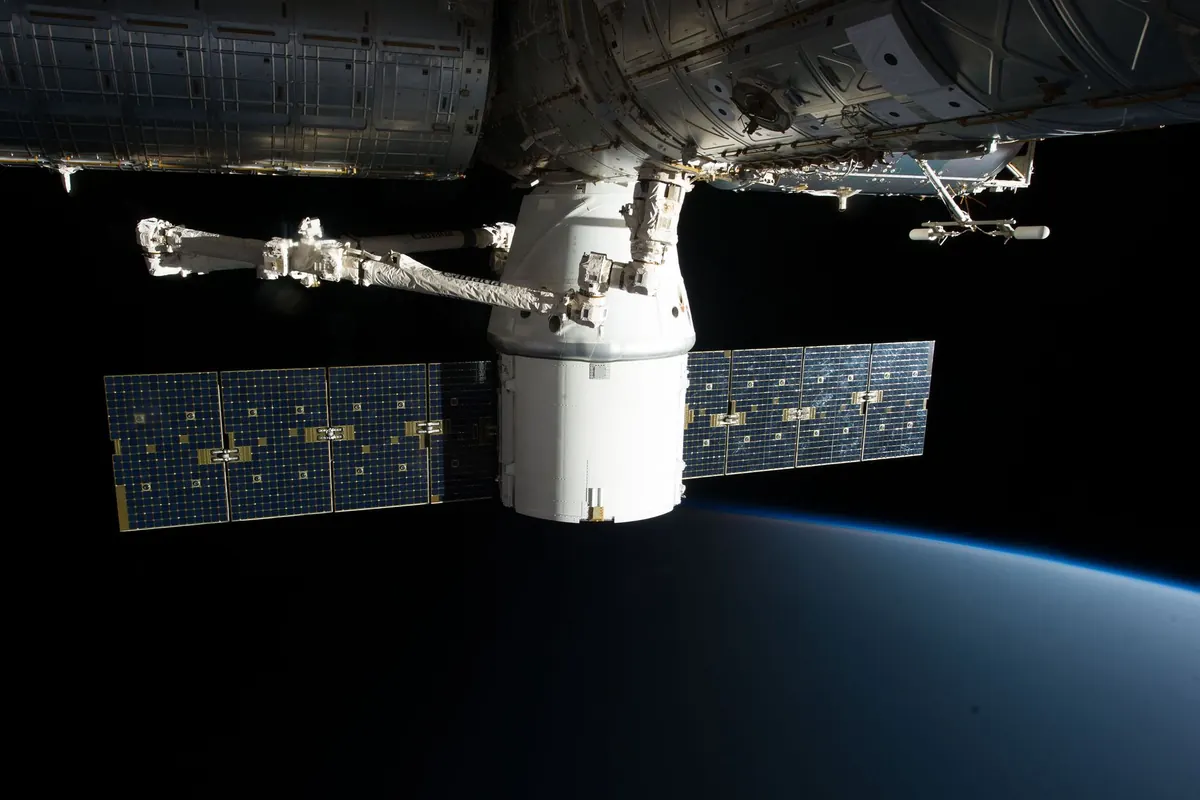
Forget the images of solar panels and modules. To the naked eye the ISS is a single, unblinking white point, brighter than most stars and occasionally brighter than anything else in the sky except the Moon. What gives it away is the movement: it crosses the sky at a slow, constant pace, taking anywhere from two to six minutes to travel from one horizon to the other.
It also has none of the tells of an aircraft. No flashing red and green navigation lights, no strobes, no engine noise, no change of course. If a light in the sky is blinking or wandering, it is a plane.
One oddity worth knowing about: on some passes the station fades out halfway across the sky. That is not a fault. It has flown into Earth's shadow and stopped being lit by the Sun. Watching it vanish mid-flight is one of the nicer sights available from a back garden.
Why passes happen at dawn and dusk
Two conditions have to line up. The station must be in sunlight, and your patch of sky must be dark. For most of the night the ISS is inside Earth's shadow and invisible; in broad daylight it is up there, but the blue sky drowns it out.
That leaves two windows: the couple of hours after sunset and the couple of hours before sunrise. In practice, sightings come in runs. You might get a fortnight of evening passes, then little worth watching for a while, then a spell of pre-dawn ones. The orbit shifts steadily, so check a tracker every few days rather than assuming the timetable never changes.
Setting up a tracker
Nobody works this out by hand. A few free tools do it properly:
- NASA's Spot the Station — web and app, with email alerts for your location a few hours before a good pass.
- Heavens-Above — the veteran of satellite prediction, dense with detail once you get used to it.
- ISS Detector — uses your phone's compass and sensors, and can nudge you just before a pass begins.
- General stargazing apps such as Stellarium or Sky Guide — useful because you can hold the phone up and see the station's path drawn across the real sky.
Whatever you choose, allow location access and check that it has your town right rather than a default city. Turn on notifications; most apps warn you ten minutes before a bright pass, which is about the time you need to find your shoes and get outside.
Reading a pass prediction
A good prediction gives you four things.
Rise time and direction
Listed as something like "22:41, appearing in the west-south-west". That is where it will first become visible, usually fairly low down.
Maximum altitude
Measured in degrees, where 0° is the horizon and 90° is straight overhead. A pass below about 20° is a disappointment — trees, rooftops and haze will swallow it. Anything above 40° justifies standing outside in a coat. A 70° or 80° pass is superb: the station crosses almost the whole sky and looks startlingly bright.
Direction of travel
Most passes run roughly west to east, because the station orbits in the same direction that Earth spins. It can also appear from the south-west, north-west or north, so read the entry rather than assuming.
Duration
Two to six minutes is typical. High, long passes last longest.
Practical tips for a UK garden
- Find a spot with a clear view towards the west and east, where most passes begin and end. A low fence is fine; a leylandii hedge is not.
- Give your eyes ten minutes to adapt. Switch off the kitchen light, leave the phone in your pocket, and let your night vision build.
- Lean on a wall or a shed. Following the whole sky is easier when you are not swaying.
- Check the forecast rather than the clock. Cloud is the real obstacle in this country, and if tonight is a washout the next decent pass usually arrives within days.
- Skip the binoculars. The ISS is a point of light, and optics narrow your field of view just as the target is moving quickly. Naked eye wins here.
Bright passes, dim ones, and common mix-ups
Brightness varies a great deal. A pass that goes nearly overhead while the station is still in full sunlight can be brilliant. The same station on a low pass through hazy air can look like a mediocre star. Do not treat a dim pass as a failure; you have still seen it.
The usual confusions:
- Aircraft — flashing lights, engine noise, slower apparent motion, and it may turn.
- Other satellites — plenty are visible, but most are fainter than the ISS and harder to pick out.
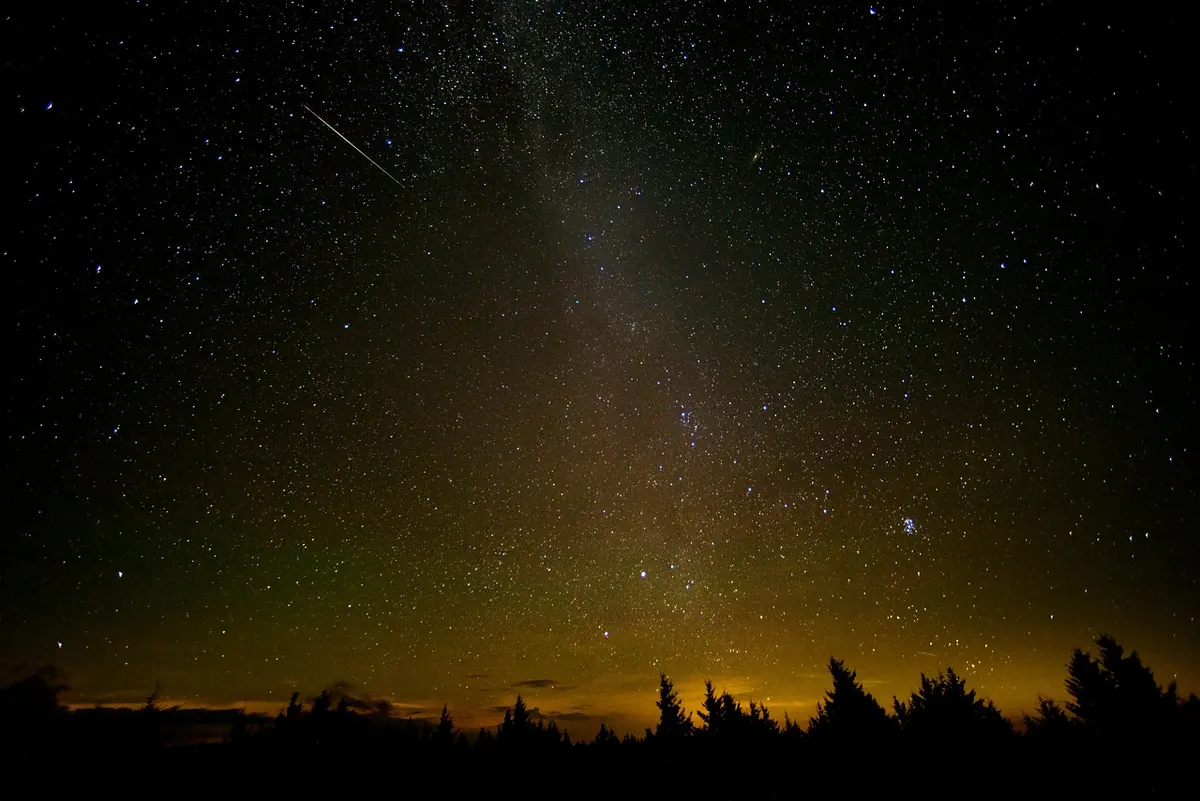
- Meteors — gone in a second or two, often with a trail. The ISS takes minutes.
- Venus or Jupiter — bright and steady, but they do not move across the sky.
- Starlink trains — a line of evenly spaced dots moving together, not one point.
Your first sighting: a five-minute routine
- Check a tracker in the afternoon and note the rise time, direction and maximum altitude.
- Set an alarm for ten minutes before that time.
- Go outside, face the stated direction, and let your eyes settle.
- Look low. Beginners sweep the top of the sky and miss the first thirty seconds. The station usually appears near the horizon and climbs.
- Once you have it, follow it. When it reaches its highest point, that is the moment to point it out to whoever is standing next to you.
Do that a few times and it becomes a habit. Pass predictions start to feel as ordinary as the weather forecast, and every so often you get a clear evening, an overhead pass and six uninterrupted minutes of watching people orbit the planet from your own back step.
Photo: SpaceX / Pexels